
The house of the Vettii
One of ancient Pompeii’s best celebrated mansions is the “House of the Vettii” known as Pompeii’s Sistine Chapel. Its interiors still preserve the iconographic layout considered one of the highest expressions of Roman art in the 1st century AD.
The owners of this faboulous dwelling were two former slaves, Aulus Vettius Conviva and Aulus Vettius Restitutus. After being freed from slavery and becoming liberti (freedmen), the Vettii specialized in selling wine and other agricultural products of the Vesuvian area and in a short time they became really wealthy.
Convivia became so powerful and prosperous that he made a large donation to the city that allowed him to enter the Brotherhood of Augustus, the highest civic office open to freedmen.
The ambition of the two liberti was not only to become so rich as to redeem themselves in the eyes of all the inhabitants of Pompeii, but they also wanted to prove their high cultural level, demonstrating their new status of free men and aristocrats.
The house of the Vettii dates to a time when Pompeii was deeply damaged by the hearthquake of the year 62 AD and many elite families left the town leaving space for a new class of people that started inhabiting the city: the freedmen. Those people acquired many lands and houses and soon became the “nouveau-riche “ and tried hard to pursue the social status of aristocrats. Among them the Vettii were ranked as the most influential, therefore they decided to decorate their house appropriately for their new social status by displaying iconography related to the latest values of the renewed society such as wealth, sex and power.
The house of the Vettii – Cenatio
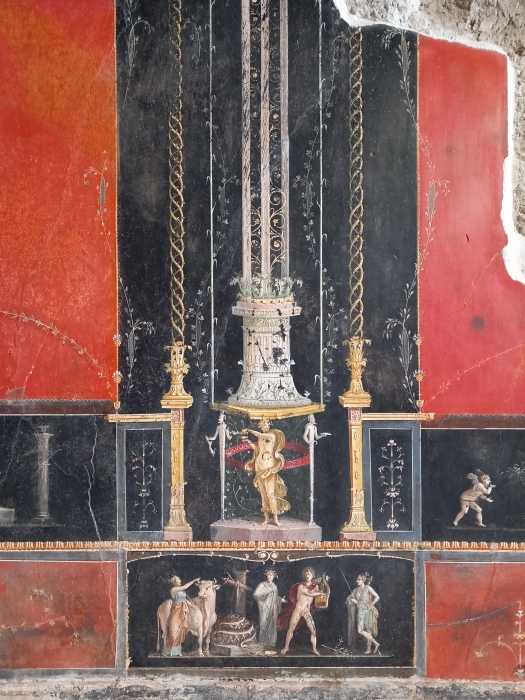
In order to ensure that their mansion was fashionable and tasteful all the halls were decorated with exceptional frescoes illustrating the Greek mythology and the most iconic episodes demostrating a decorative intent of a higher art that transformed the rooms into a kind of picture gallery according to the stardards of a pinacotheca.
This beautiful mansion contains one of the best known sets of IV style paintings and a combination of the so called four styles.
On the plinth of the atrium, children are depicted offering sacrifices to the Penates thus referring to the cult of the ancestors. Cupids sacrificing to the goddess Fortuna are represented on the north wall, next to a large ark, where precious objects were kept and shown to the public.
The lararium of the nearby service rooms features the Genius Loci with dancing larii and a serpent, symbol of good fortune.
The walls of the triclinium to the left of the atrium are embellished with frescoes showing many mithological scenes: Zeus with Leda and Danae are represented in the top area, while the frameworks in the middle describe the Metamorphosis of Cyparriso, the Fight between Eros and Pan in the presence of Dionysus and Ariadne. (The latter indicates the state of anxiety and joy inherent in the love experience).
The black panels of the portico show Urania and a poet alluding to the intellectual activity the porch was used for.
House of the Vettii
Two spectacular exedras flank the atrium: the southern one, known as Pentheus’s room, shows architectural views on a yellow background and, in the centre of the left wall, a box shows Hercules as a boy choking the snakes sent by Juno, in the presence of Alcmena, his mother, Amphitryon, his adoptive father, and Zeus, his father, in the form of an eagle. On the central wall poor Pentheus grabbed by the hair by the Maenads who hurl stones at him and kill him is depicted. Finally, on the right wall is the story of the Sacrifice of Dirce, between Amphion and Zetus.
The northern exedra, known as Ixion’s exedra, presents in its centre the Sacrifice of the Thessalian king Ission, accused of having molested Juno. The king is tied to a wheel in the presence of Juno, Vulcan, Iris and Mercury, at whose feet is Nephele kneeling. On the right wall is the representation of Dionysus taking to the edge of the world and meeting Ariadne abandoned by Theseus on the island of Naxos. On the left wall, on the other hand, there is a representation of the myth of Daedalus delivering the wooden cow to Pasiphae.
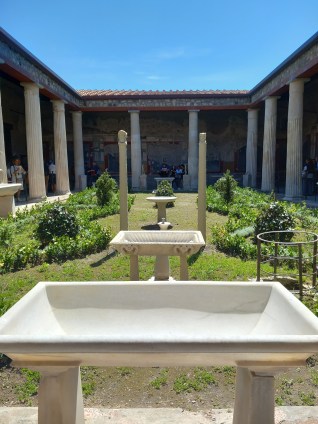
The viridarium garden is adorned with objects in vogue during the imperial age, such as tables for displaying furnishings, fountains in the form of children, herms, marble water basins and statues of Satyrs, Dionysus and Priapus.
Finally, at the centre of the northern wall of the viridarium is the Cenatio, one of the most beautiful rooms in Pompeii that is decorated with themes that seem to recall the Renaissance paintings of later centuries.
The upper wall panels are decorated with pairs of lovers and gods including Poseidon.
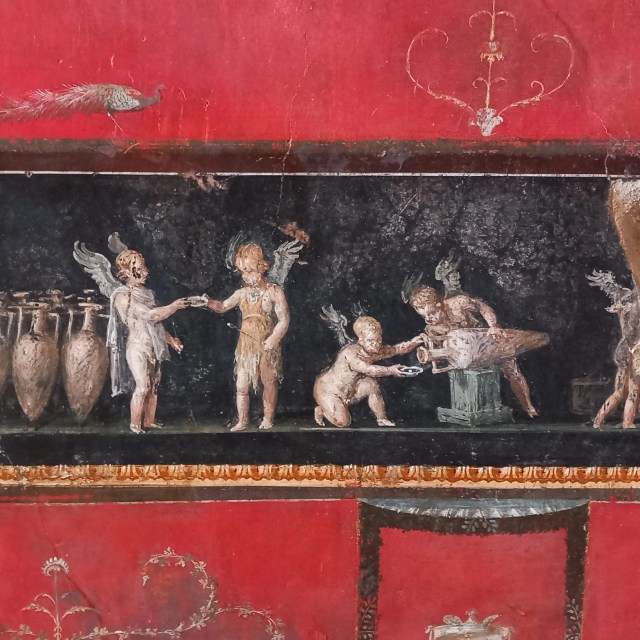
The central frieze is among the most extraordinary representations: it depicts cupids and psychai engaged in a variety of activities that are of considerable value for understanding life in the later years of the city. There is meat-processing, the cultivation of flowers for perfume production, goldsmiths’ work and a blacksmith’s forge, bread-making, the cleaning of garments, the pouring of wine and the grape harvest. There is even a hellenistic repertoire depicted in the scenes representing the archery contest, the chariot race and the triumph of Dionysus with his festive procession.
The most celebrated painting of this marvellous dwelling is that of the ityphallic Priapus, god of prosperity, placed on the entrance wall. The god is weighing his enormous phallus against a bunch of money and symbolizes power and virility besides protecting the house from thieves and enemies.
In order to visit the House of the Vettii with a qualified tourist guide please do not hesitate to contact me at: belsannino@gmail.com
© 2023 Dr Maria Sannino


 Dr Maria Sannino